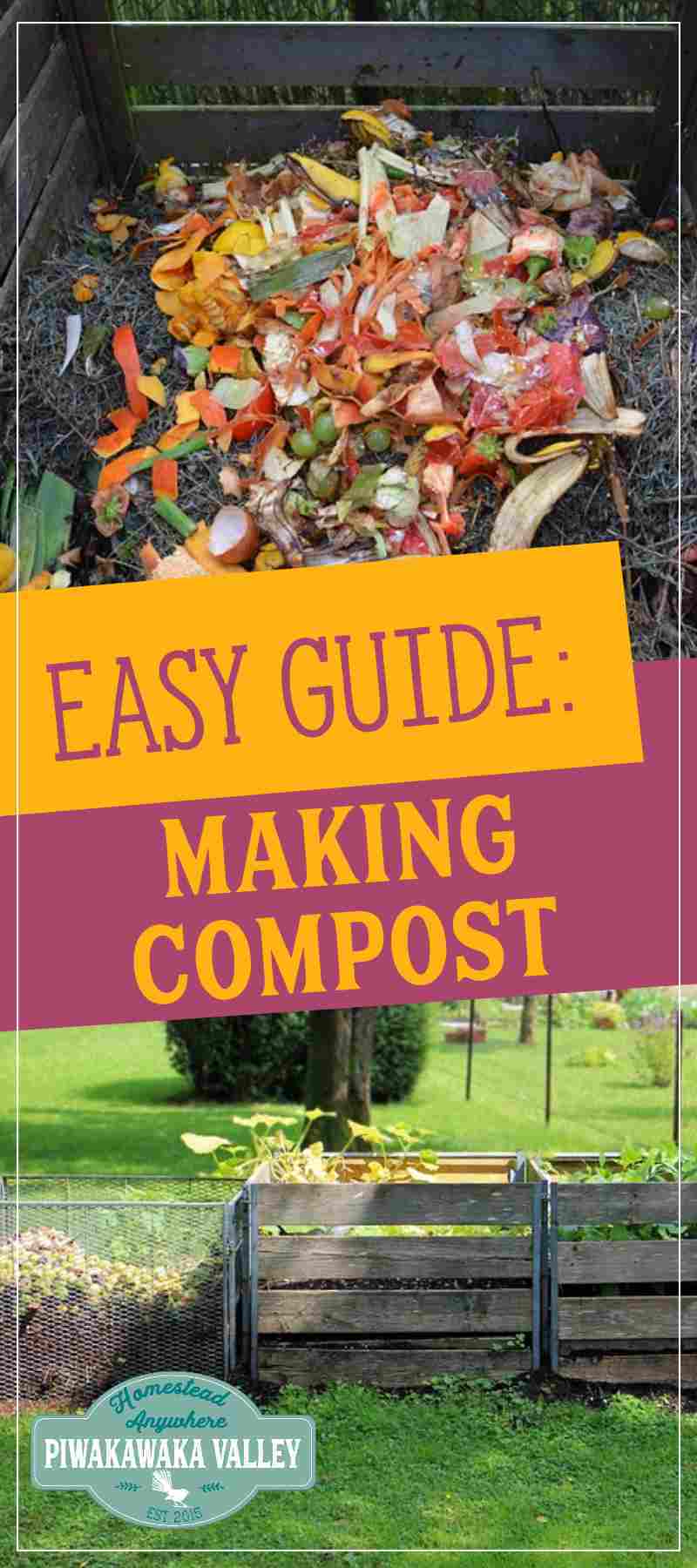

Ask ten experienced gardeners what the secret is to growing healthy vegetables, beautiful flowers and productive fruit trees, and most of them will give the same answer.
Healthy soil.
While fertilisers certainly have their place, nothing transforms a garden quite like good compost. Rich, dark, crumbly compost feeds the soil, improves drainage, helps sandy soils hold water, encourages earthworms, supports billions of beneficial microorganisms and slowly releases nutrients exactly where your plants need them.
Please read: This information is provided for educational purposes only and is not intended to treat, diagnose or prevent any disease. We encourage you to make your own health care decisions in partnership with a qualified health care professional.
This post contains affiliate links, this means at no extra cost to you, we make a commission from sales. Please read our Disclosure Statement
It’s one of the few things in gardening that seems almost magical.
You take kitchen scraps, weeds, leaves, animal bedding and other materials that would otherwise become waste, pile them together, and nature quietly turns them into one of the best soil improvers you’ll ever use.
Better still, making compost isn’t complicated.
Many people never start because they’re worried about getting the ratios exactly right or building the perfect compost bin. The reality is that nature has been composting fallen leaves, dead plants and animal manure for millions of years without anyone measuring ingredients.
Your compost pile doesn’t need to be perfect.
It simply needs to exist.
Over the years I’ve experimented with trenches, pallet compost bins, animal bedding, manure and all sorts of compost ingredients. Some piles have heated beautifully while others have taught me valuable lessons about moisture, airflow and carbon-to-nitrogen ratios.
The wonderful thing is that every compost pile teaches you something, and every pile helps your garden become healthier than it was before.
In this guide I’ll show you everything I’ve learnt about making amazing compost—from choosing a compost system through to troubleshooting common problems and producing beautiful compost that your garden will love.
Quick Answer
Compost is made by combining nitrogen-rich “greens” with carbon-rich “browns”, keeping the pile about as damp as a wrung-out sponge and allowing beneficial microorganisms to break everything down. A good compost pile has plenty of air, enough moisture, a good balance of ingredients and time. With the right conditions you can make finished compost in as little as 8–12 weeks, although slower composting methods may take several months.
Contents
- What is Compost?
- Why Compost is So Important
- How Compost Works
- Different Ways to Compost
- Choosing the Best Compost Bin
- Greens and Browns Explained
- How to Build a Compost Pile
- What Can Go Into Compost?
- What Shouldn’t Go Into Compost?
- Using Animal Manure Safely
- Turning and Maintaining Compost
- When Compost is Ready
- How to Use Compost
- Common Compost Problems
- Frequently Asked Questions
What is Compost?
Compost is decomposed organic matter that has been transformed by billions of microorganisms into a stable, nutrient-rich material that improves soil health.
Although we often think of compost as a fertiliser, it’s actually much more than that.
Compost feeds the entire soil ecosystem.
As bacteria, fungi, worms and countless other tiny organisms consume organic material, they convert it into humus—a stable form of organic matter that improves almost every aspect of your soil.
Healthy compost helps heavy clay soils drain better, while also allowing sandy soils to retain moisture for much longer. It improves soil structure, buffers nutrients, increases biological activity and provides a slow, steady supply of nutrients to your plants.
In other words, compost doesn’t just feed your vegetables.
It creates healthier soil that can continue feeding your vegetables for years to come.
RELATED: The Benefits of Compost in Your Garden
Why Every Gardener Should Make Compost
If I could only recommend one habit that would improve almost every garden, it would be making compost.
Whether you’re growing vegetables in raised beds, creating a food forest, planting fruit trees or maintaining flower gardens, compost improves the soil that everything depends on.
One of the things I love most about composting is that it turns waste into one of the most valuable resources on the property.
Kitchen scraps become soil.
Autumn leaves become soil.
Grass clippings become soil.
Animal bedding becomes soil.
Instead of paying to remove organic material, you’re recycling it back into the garden where it belongs.
Over time you’ll probably find yourself looking at piles of leaves, weeds and garden prunings completely differently.
They’re no longer rubbish.
They’re future compost.
RELATED: How to Build Healthy Garden Soil
The Amazing Biology Inside a Compost Pile
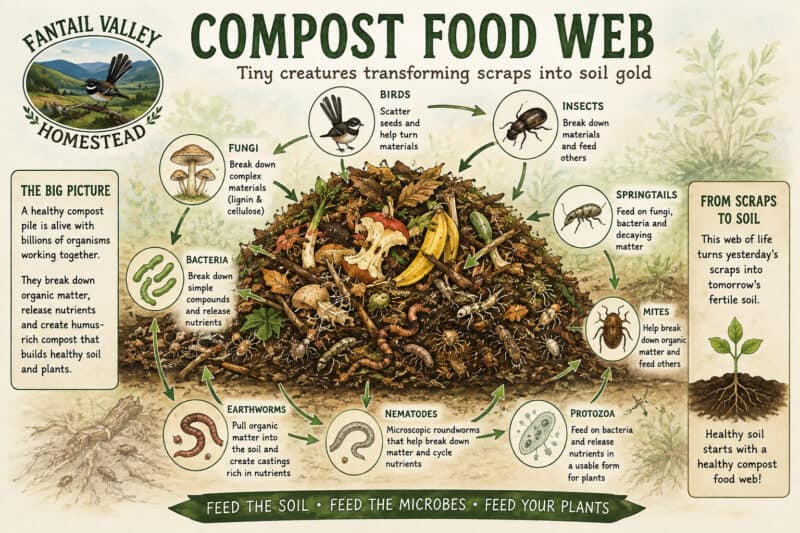
One of the reasons compost fascinates me is that it looks so simple from the outside, yet inside it’s one of the busiest ecosystems you’ll ever create.
As soon as you begin adding organic materials together, billions of bacteria start breaking down the easiest-to-digest ingredients.
As temperatures rise, different groups of microorganisms take over.
Fungi begin digesting tougher materials like stems and woody plant tissue.
Actinomycetes, which are responsible for that wonderful earthy smell, continue breaking down materials that many bacteria can’t process.
Earthworms, beetles, mites and countless other tiny creatures gradually join the process as the pile cools.
Together they transform coarse organic matter into dark, stable humus.
The hotter your compost pile becomes, the faster these biological processes generally occur.
In an actively managed hot compost pile, temperatures can exceed 60°C, destroying many weed seeds and reducing plant pathogens while dramatically speeding up decomposition.
Even slower compost piles eventually reach the same destination—they simply take a little longer.
Compost is the Foundation of a Productive Garden
Whenever people ask me how to grow healthier vegetables, they often expect me to recommend a particular fertiliser.
Instead, I nearly always begin by talking about compost.
Healthy plants begin with healthy soil.
Healthy soil begins with organic matter.
Compost improves almost every gardening project you’ll ever undertake.
It’s one of the reasons you’ll find me mentioning compost throughout this website, whether we’re discussing tomatoes, cucumbers, fruit trees, seed starting or building a productive homestead.
Nearly every successful garden starts in exactly the same place.
With the soil.
RELATED: How to Start a Homestead from Scratch
Different Ways to Make Compost
One of the biggest myths about composting is that there’s only one “correct” method.
In reality, there are dozens of ways to compost successfully.
The best composting system is simply the one that matches your garden, your lifestyle and the amount of material you need to process.
Some people only generate enough kitchen scraps for a small compost tumbler, while others have livestock producing wheelbarrows of manure and bedding every week.
All of these materials can become beautiful compost.
The key is choosing a system that you’ll actually use consistently.
Compost Trenches
One of the simplest composting methods I ever learnt came from my grandfather.
He always had an incredible vegetable garden, yet he rarely built large compost piles.
Instead, he dug a shallow trench through one section of the garden.
Each day he buried the family’s kitchen scraps in the next section along the trench before covering them with soil.
The following day he simply moved a little further along.
Once the trench was full, he dug another one beside it and continued the process.
By the time he eventually returned to the original trench months later, the material had completely broken down and become rich organic matter directly beneath where vegetables would grow.
It’s a wonderfully simple method if you only have modest amounts of kitchen waste.
It also keeps food scraps safely underground where rodents and flies are much less likely to find them.
Traditional Compost Piles
For many gardeners, the classic compost pile remains one of the best options.
It’s inexpensive, scalable and remarkably forgiving.
A simple pile built directly on the soil allows earthworms and other beneficial organisms to move naturally into the compost while excess moisture drains away.
The larger the pile becomes, the better it generally performs.
Small piles struggle to retain heat, whereas larger piles develop the warm conditions that encourage rapid decomposition.
If you have plenty of leaves, weeds, lawn clippings or animal bedding, a traditional compost pile is hard to beat.
Compost Bins
Compost bins help keep materials tidy while making the whole process easier to manage.
There are countless designs available, from commercial plastic bins through to homemade systems built from recycled materials.
I’ve experimented with several over the years, but I still come back to pallet compost bins as my favourite.
They’re inexpensive, easy to build and hold a generous volume of material.
The gaps between the pallet boards allow excellent airflow while still containing the compost.
Because many businesses are happy to give pallets away, they’re often one of the cheapest ways to build a large composting system.
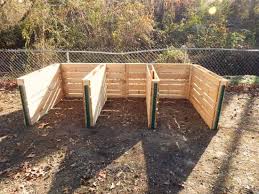
Why I Recommend Three Compost Bins
If you have the space, three adjacent compost bins are one of the most efficient systems you can build.
Each bin has a different purpose.
| Bin | Purpose |
|---|---|
| Bin 1 | Collect fresh materials every day. |
| Bin 2 | Active composting and regular turning. |
| Bin 3 | Finishing and maturing into usable compost. |
This system makes turning compost incredibly easy.
Instead of trying to mix everything within the same pile, you simply fork the contents from one bin into the next.
That process thoroughly mixes the ingredients while introducing fresh oxygen throughout the pile.
Another advantage is that neighbouring bins share walls, saving both building materials and space.
As your homestead grows, you can simply build additional bins beside the originals.
Compost Tumblers
If you’re composting for a smaller household, a compost tumbler can work extremely well.
A tumbler is simply a rotating barrel mounted on a stand.
Turning the handle mixes the compost thoroughly without needing to fork heavy material from one pile to another.
Because everything remains enclosed, tumblers generally look tidier than open compost piles and are often better suited to suburban gardens.
Their biggest limitation is size.
For a homestead producing large volumes of weeds, leaves, manure and animal bedding, a tumbler fills surprisingly quickly.
However, for processing everyday kitchen scraps from a family of two to four people, they’re an excellent option.
I’ll keep my existing recommendation here because it’s still a solid choice.
Composting with Chickens
One composting system I’d love to continue expanding is composting alongside chickens.
If you’ve ever watched a flock scratching through a pile of leaves, you’ll understand why.
Chickens naturally turn compost for you.
As they search for insects, worms and seeds, they constantly scratch and mix the material, introducing oxygen while helping break larger pieces into smaller ones.
Their manure also contributes valuable nitrogen to the pile.
Karl Hammer has become well known for using chickens as part of his composting system, and his results are incredibly impressive, many homesteaders now implement this wonderful synergistic system.
While most home gardeners won’t build compost systems on the same scale, there are still plenty of ideas worth learning from.
Hot Compost vs Cold Compost
Many gardeners worry that their compost isn’t getting hot enough.
In reality, both hot composting and cold composting produce excellent compost.
The difference is mainly how quickly it happens.
Hot composting relies on building a large enough pile with the correct balance of moisture, oxygen and nutrients to encourage rapid microbial activity.
Temperatures often rise above 55°C and may exceed 65°C.
These higher temperatures speed decomposition, destroy many weed seeds and reduce numerous plant diseases.
Cold composting is much slower.
Instead of carefully managing the pile, materials are simply added as they become available and allowed to decompose naturally.
The finished compost is still excellent—it simply takes longer to produce.
For many busy gardeners, that’s a perfectly reasonable trade-off.
Which Composting Method is Best?
There isn’t one perfect composting method.
The best system is the one that suits your lifestyle and encourages you to compost consistently.
If you have a suburban backyard, a tumbler or small compost bin may be ideal.
If you have a lifestyle block or homestead, pallet bins or large compost piles usually make much more sense.
The important thing isn’t the container.
It’s turning organic waste into healthy soil instead of sending it to landfill.
Every compost pile, regardless of size, is an investment in the long-term health of your garden.
Understanding Greens and Browns
If you’ve read anything about composting before, you’ve almost certainly come across the terms “greens” and “browns”.
These two groups form the foundation of every successful compost pile.
The good news is that they’re much simpler than they sound.
Greens are materials that are rich in nitrogen. They usually contain plenty of moisture, decompose quickly and provide the protein that compost microorganisms need to multiply.
Browns are materials that are rich in carbon. They tend to be drier, break down more slowly and provide the energy source that keeps those same microorganisms working.
Think of it like cooking a balanced meal.
Too much of one ingredient and the recipe doesn’t work very well. Get the balance roughly right and nature does the rest.
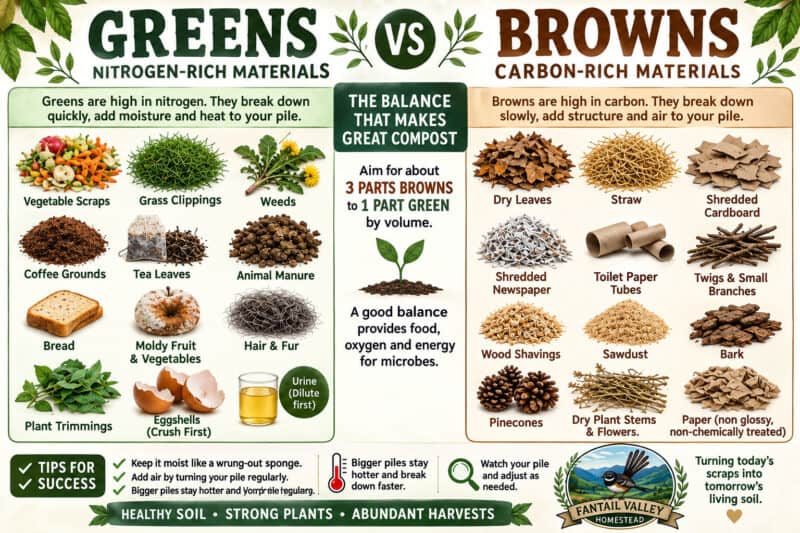
What Counts as a Green?
Greens are usually fresh, soft materials that have recently been alive.
Many of them come directly from your kitchen or vegetable garden.
Excellent green materials include:
- Vegetable scraps.
- Fresh grass clippings.
- Young weeds before they set seed.
- Coffee grounds.
- Tea leaves.
- Fresh garden prunings.
- Animal manure.
- Bread in small quantities.
- Mouldy fruit and vegetables.
- Hair and animal fur.
- Urine (yes, it’s an excellent source of nitrogen).
Most households naturally produce plenty of green materials every week, especially if you’re cooking from scratch.
What Counts as a Brown?
Browns are the carbon-rich ingredients that give your compost pile structure while balancing all those moist green materials.
Many gardeners actually struggle to collect enough browns, particularly through spring and summer.
Good brown materials include:
- Dry autumn leaves.
- Straw.
- Shredded cardboard.
- Plain newspaper.
- Paper towel rolls.
- Toilet roll tubes.
- Wood shavings.
- Sawdust from untreated timber.
- Small twigs.
- Wood chips.
- Dry plant stems.
Every autumn I see piles of leaves being taken to landfill, yet they’re one of the best compost ingredients you’ll ever find.
If you have the storage space, collect more leaves than you think you’ll need. They’ll become incredibly valuable over the following year.
Do You Need Exact Ratios?
One of the biggest things that stops people composting is the belief that every bucket of compost ingredients must be measured precisely.
Fortunately, nature isn’t nearly that fussy.
You’ll often hear recommendations such as 25:1 or 30:1 carbon-to-nitrogen ratios.
Those figures are useful for understanding how compost works, but they aren’t something most home gardeners need to calculate.
A much simpler approach works perfectly well.
If your pile is wet, slimy or smells unpleasant, add more browns.
If it’s dry, slow and doesn’t seem to be breaking down, add more greens and a little water.
For most home compost piles I recommend roughly three buckets of browns for every bucket of greens.
Don’t worry if it’s not exact.
Your compost pile is surprisingly forgiving.
How to Build a Compost Pile
Building your first compost pile is much easier than many people expect.
Start with a coarse layer of sticks or small branches if drainage is poor.
This creates air spaces beneath the pile and prevents the bottom becoming waterlogged.
Next, begin layering greens and browns as they become available.
Some gardeners build distinct layers.
Others simply mix materials together as they add them.
Both methods work.
The important thing is avoiding large clumps of any single ingredient.
If you’re adding a thick layer of fresh grass clippings, balance it with plenty of dry leaves or shredded cardboard.
If you’ve collected lots of dry autumn leaves, add kitchen scraps or manure to keep decomposition moving.
As the pile grows, water each layer lightly if conditions are dry.
Your goal is moisture similar to a wrung-out sponge.
Damp enough to support microbial life.
Not so wet that water drips out when squeezed.
What Can You Compost?
One of the most common questions I hear is:
“Can I compost this?”
The answer is usually yes.
Anything that was recently alive will eventually decompose.
The question is usually how quickly it will break down and whether it’s suitable for a home compost system.
Some excellent materials include:
- Kitchen fruit and vegetable scraps.
- Garden weeds before they seed.
- Spent vegetable plants.
- Coffee grounds and filters.
- Tea leaves.
- Leaves.
- Grass clippings.
- Untreated sawdust.
- Animal bedding.
- Straw.
- Cardboard.
- Paper.
- Hair.
- Feathers.
- Eggshells (crushed).
The more varied your ingredients, the healthier and more diverse your compost biology generally becomes.
What Shouldn’t Go Into Your Compost?
While home compost piles can process an astonishing range of materials, there are a few things I prefer leaving out.
Meat and Dairy
These can attract rats, mice and flies, especially in smaller backyard compost systems.
Very large, actively managed hot compost piles can process them successfully, but for most home gardeners they’re best avoided.
Diseased Plants
Unless you’re confident your pile regularly reaches high temperatures, it’s safer to dispose of badly diseased plants elsewhere.
Some diseases survive cool compost piles surprisingly well.
Weeds with Mature Seeds
Many weed seeds survive ordinary composting.
Adding them may simply spread the problem throughout your garden later.
Potatoes
Small potatoes often survive composting and have an uncanny ability to sprout everywhere you spread finished compost.
Ask me how I know!
Using Animal Manure Safely
Animal manure is one of the very best compost ingredients available.
It provides valuable nitrogen, feeds soil biology and dramatically speeds decomposition when balanced with enough carbon-rich materials.
Chicken manure, rabbit manure, sheep manure, goat manure, horse manure and cattle manure can all become excellent compost.
However, one important caution deserves mentioning.
Some hay, straw and pasture have been treated with persistent broadleaf herbicides.
These chemicals can survive digestion, pass through animals unchanged and remain active in manure and compost for months—or even years.
If contaminated manure reaches your vegetable garden it can severely damage tomatoes, beans, peas, cucumbers and many other sensitive crops.
If you’re using manure from an unknown source, I strongly recommend performing a simple bioassay before spreading large quantities throughout your garden.
RELATED: Persistent Herbicide Damage in Gardens
RELATED: How to Fix Soil Contaminated with Persistent Herbicides
How to Maintain Your Compost Pile
Once you’ve built your compost pile, nature does most of the hard work.
Your role is simply to provide the conditions that allow the billions of microorganisms inside the pile to thrive.
There are four things they need:
Food.
Moisture.
Air.
Time.
If those four requirements are met, your compost pile will usually look after itself remarkably well.
How Wet Should Compost Be?
One of the most common reasons compost piles stall is incorrect moisture.
If the pile becomes too dry, the microorganisms responsible for decomposition slow down dramatically.
If it becomes waterlogged, oxygen disappears and unpleasant anaerobic bacteria begin taking over.
I like to use the “wrung-out sponge” test.
Grab a handful of compost and squeeze it gently.
It should feel damp, but only produce one or two drops of water.
If water streams out, it’s too wet.
If it feels dusty or falls apart completely, it needs watering.
During long dry summers I occasionally water the compost pile just as I would the vegetable garden.
In very wet climates, covering the pile with old roofing iron, timber or a simple roof can prevent it becoming saturated while still allowing airflow around the sides.
Why Turning Compost Speeds Everything Up
Turning compost isn’t absolutely essential, but it certainly speeds the process.
As microorganisms consume oxygen inside the pile, the centre gradually becomes depleted.
Turning the pile introduces fresh oxygen while mixing wetter materials with drier ones and breaking up compacted sections.
For actively managed hot compost, I usually recommend:
- Weekly turning during the first month.
- Every two to four weeks after that.
- Less frequently once the pile begins maturing.
If you’re using the three-bin system, turning becomes very easy.
Simply fork the contents from one bin into the next.
Every forkful becomes mixed naturally, creating a beautifully aerated compost pile.
If life gets busy and you don’t turn your compost for a while, don’t worry.
It will still become compost.
It will simply take a little longer.
Should You Cover Your Compost?
Whether to cover compost depends largely on your climate.
In areas with frequent rainfall, a cover helps prevent nutrients washing out while keeping the pile from becoming waterlogged.
In hot, dry climates a cover reduces evaporation and helps retain valuable moisture.
I generally prefer a simple cover that keeps off excessive rain while still allowing plenty of airflow through the sides.
A compost pile needs oxygen almost as much as it needs moisture.
How Long Does Compost Take?
This is probably the question every new composter asks.
The honest answer is:
It depends.
A well-built hot compost pile that’s actively managed can produce beautiful finished compost in around eight to twelve weeks.
Cold compost piles often take six months to a year.
Both methods produce excellent compost.
The difference is simply how quickly nature works.
Rather than worrying about the calendar, I prefer watching the compost itself.
It tells you when it’s ready.
How to Tell When Compost is Finished
Finished compost looks completely different from the pile you originally built.
Most of the original ingredients should no longer be recognisable.
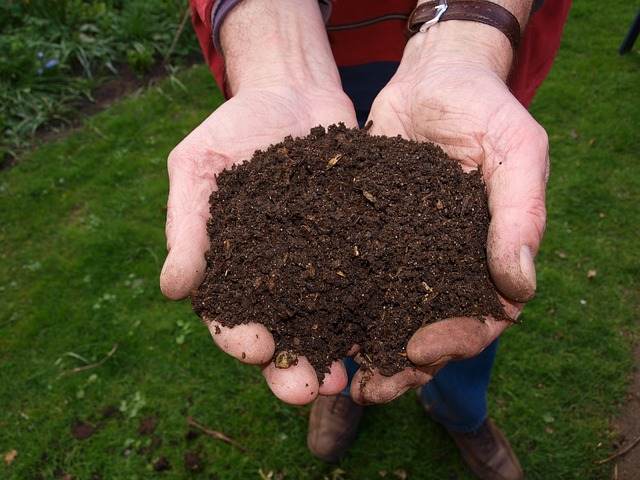
Instead you’ll have a dark, crumbly material with a pleasant earthy smell.
Good compost should:
- Be dark brown to almost black.
- Feel soft and crumbly.
- Smell like fresh forest soil.
- Contain very few recognisable ingredients.
- Be cool rather than warm.
If your compost still contains the occasional twig or small wood chip, don’t worry.
Simply screen it if you want a finer product, or return the larger pieces to your next compost pile where they’ll continue decomposing.
How to Use Finished Compost
This is the fun part.
All those months of collecting scraps, turning piles and waiting patiently finally pay off.
I use compost almost everywhere in the garden.
Vegetable beds receive a generous layer before planting.
Fruit trees benefit from compost spread beneath the drip line.
Flower gardens, berry bushes and perennial herbs all appreciate regular additions.
Finished compost also makes an excellent ingredient in homemade potting mixes when combined with coarse materials that improve drainage.
Unlike many fertilisers, compost doesn’t simply feed plants for a short period.
It continues improving soil structure and biology long after it’s been applied.
Every wheelbarrow of compost you spread is another investment in healthier soil for future seasons.
RELATED: Growing Healthy Seedlings from Seed
Can You Use Compost as Mulch?
Absolutely.
A layer of mature compost spread over the soil surface works beautifully as a nutrient-rich mulch.
Earthworms gradually pull it down into the soil while rainfall carries dissolved nutrients towards plant roots.
I often apply compost first, then cover it with straw or other organic mulch.
The compost feeds the soil while the mulch conserves moisture and suppresses weeds.
It’s a combination that works exceptionally well in vegetable gardens.
RELATED: Why Mulching Makes Every Garden Better
Compost Tea vs Compost
Many gardeners ask whether compost tea is better than simply applying compost.
Personally, I see them as serving different purposes.
Finished compost builds long-term soil health by adding stable organic matter and feeding soil life.
Compost tea is a liquid extract that can introduce microorganisms and soluble nutrients to soil or foliage.
If I had to choose only one, I’d always choose making excellent compost first.
Healthy compost provides benefits for years, whereas compost tea works best as a supplementary practice rather than a replacement.
The quality of your compost will always determine the quality of any compost tea you make.
Every Compost Pile is Different
One of the wonderful things about composting is that no two piles are exactly the same.
Every garden produces different materials.
Every climate behaves differently.
Every season changes the ingredients available.
Don’t worry about trying to copy someone else’s compost pile perfectly.
Learn how your own pile behaves.
Observe it.
Adjust it.
Experiment.
Before long you’ll instinctively recognise when it needs more moisture, more carbon or a quick turn.
That’s experience you simply can’t learn from a book.
Common Compost Problems (and How to Fix Them)
Even experienced gardeners occasionally end up with a compost pile that isn’t behaving quite as expected.
The good news is that compost is incredibly forgiving.
Most problems have a simple solution, and with a few small adjustments your pile will soon be back on track.
| Problem | Likely Cause | Solution |
|---|---|---|
| Bad smell | Too wet or lacking oxygen | Turn the pile and add dry brown materials. |
| Pile won’t heat up | Too small, too dry or not enough nitrogen | Add greens, water lightly and increase pile size. |
| Pile is soggy | Too much rain or too many greens | Mix in cardboard, leaves or straw and improve drainage. |
| Pile is dry | Not enough moisture | Water while turning until damp like a wrung-out sponge. |
| Lots of flies | Food scraps exposed | Cover fresh kitchen scraps with leaves or finished compost. |
| Rodents visiting | Meat or exposed food scraps | Avoid meat and bury fresh scraps inside the pile. |
Should You Buy Compost Activators?
Garden centres sell countless compost starters and activators that promise to speed decomposition.
Personally, I don’t think they’re necessary for most home gardeners.
A shovel of finished compost, a little healthy garden soil or a bucket of fresh manure already contains billions of microorganisms ready to begin the process.
Nature has been making compost long before commercial compost activators existed.
If your pile has the right balance of greens, browns, moisture and oxygen, it already has everything it needs.
Can You Add Biochar to Compost?
Yes—and I actually think this is one of the best ways to use biochar.
Fresh biochar acts like a sponge, absorbing nutrients and providing countless tiny pores where beneficial microorganisms can live.
Charging biochar inside an active compost pile allows it to become loaded with nutrients before it’s added to the garden.
Instead of temporarily tying up nutrients in the soil, compost-charged biochar becomes an incredibly valuable long-term soil amendment.
RELATED: Read more about improving soil health.
Leaf Mould: One of Nature’s Best Soil Improvers
Not everything has to become traditional compost.
Autumn leaves deserve a special mention because they can also be composted on their own to make leaf mould.
Unlike ordinary compost, leaf mould is produced mainly by fungi rather than bacteria.
It takes longer to make—often one to two years—but the finished product is fantastic for improving soil structure and water retention.
If you have access to large quantities of deciduous leaves each autumn, I highly recommend creating a separate leaf mould pile.
Your future vegetable garden will thank you.
Worm Composting
If you don’t produce enough material for a large compost pile, worm farming is another excellent option.
Composting worms rapidly convert kitchen scraps into worm castings, one of the richest organic fertilisers available.
They also produce a valuable liquid that many gardeners use around the garden once diluted appropriately.
Worm farms work particularly well in urban gardens because they’re compact, tidy and process kitchen scraps very efficiently.
Many gardeners eventually use both systems—a worm farm for kitchen waste and a larger compost pile for garden materials.
Composting is One of the Best Investments You’ll Ever Make
If you’ve read this far, you’ve probably realised that composting isn’t really about getting rid of waste.
It’s about creating fertility.
Every banana peel, autumn leaf, grass clipping and wheelbarrow of weeds has the potential to become something incredibly valuable.
Instead of constantly buying bags of compost or relying on synthetic fertilisers, you’re gradually creating your own living soil amendment from materials you already have.
That’s one of the reasons composting sits at the heart of almost every successful vegetable garden, food forest and homestead.
Healthy compost leads to healthy soil.
Healthy soil leads to healthy plants.
Healthy plants produce healthy food.
It’s a beautifully simple cycle.
Frequently Asked Questions
How long does compost take to make?
A well-managed hot compost pile can be ready in around two to three months. Cold compost usually takes six to twelve months.
Does compost need turning?
No, but turning introduces oxygen and usually speeds decomposition considerably.
Can I compost citrus?
Yes. Small household quantities of citrus break down perfectly well.
Can I compost onions?
Yes. They may take slightly longer to decompose but are perfectly suitable for composting.
Can I compost weeds?
Yes, provided they haven’t set seed and aren’t carrying serious diseases.
Can I compost bread?
Small amounts are generally fine, although it’s best buried inside the pile to discourage pests.
Can I compost paper towels?
Yes, provided they haven’t been contaminated with grease, chemicals or cleaning products.
Should compost smell?
Healthy compost should smell earthy, like a forest after rain. Strong unpleasant smells usually indicate too much moisture or insufficient oxygen.
Can I use fresh manure directly in the vegetable garden?
It’s generally better to compost manure first. Composting stabilises nutrients and reduces the risk of burning plants or introducing pathogens.
Can compost replace fertiliser?
Compost dramatically improves soil health and supplies many nutrients, although some heavy-feeding crops may still benefit from additional fertiliser depending on your soil.
Can you compost in winter?
Absolutely. Composting simply slows down during colder weather before becoming more active again as temperatures rise.
Final Thoughts
If there is one habit that has transformed my gardens more than almost anything else, it’s making compost.
Every season I become a little more convinced that healthy gardens begin beneath the surface.
The tomatoes, cucumbers, pumpkins and fruit trees are simply the visible result of what’s happening in the soil below.
You don’t need expensive equipment.
You don’t need a perfect compost recipe.
You simply need to begin.
Start collecting kitchen scraps.
Gather autumn leaves.
Build your first pile.
Observe what happens.
Your first compost pile probably won’t be perfect.
Mine certainly wasn’t.
But every compost pile gets a little better, and every pile leaves your garden healthier than it was before.
That’s one of the wonderful things about gardening.
Nature is always willing to teach us if we’re prepared to pay attention.
Continue Learning
- Starting a Vegetable Garden from Scratch
- How to Grow Vegetables from Seed
- The Complete Companion Planting Guide
- How to Grow Tomatoes
- How to Grow Cucumbers
- Persistent Herbicide Damage
- Fixing Contaminated Soil
- How to Start a Homestead





Please Pin and Share with your friends.